
01 · Fast-WAM
Predict fewer future frames
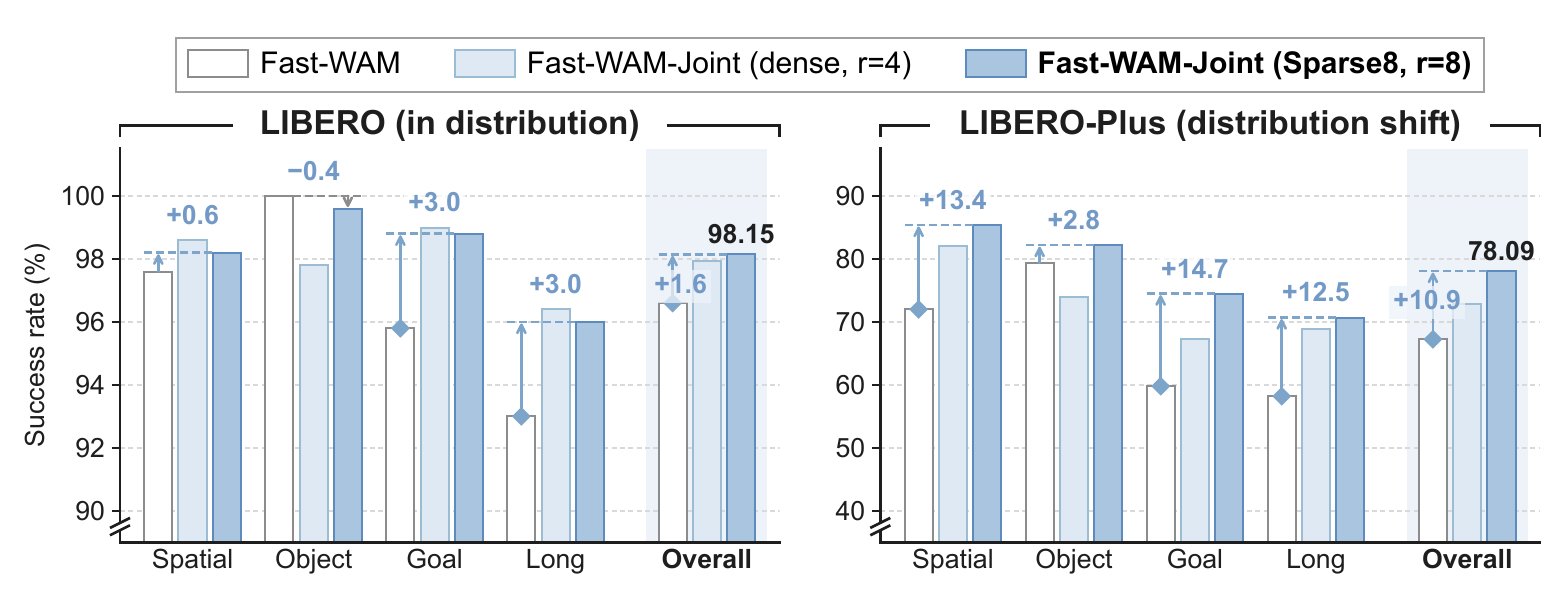
Four future frames outperform eight over the same horizon: 72.90 → 78.09% on LIBERO-Plus.
 Δ Flow Matching for Robot Foundation Models
Learn the change from history, not from fixed Gaussian noise.
MARS Lab, Nanyang Technological University

Actions and scenes change continuously, and the robot already knows its recent past. Δ-flow starts the flow there, so the network only learns a small change Δ.
Illustrative trajectories. Grey: executed history. Dashed: the next action chunk.
History-based sources. Existing backbones. One-step prediction.

FLUX.2-klein-base-4B + action DiT
Wan2.2-TI2V-5B + action DiT
PaliGemma + Gemma action expert
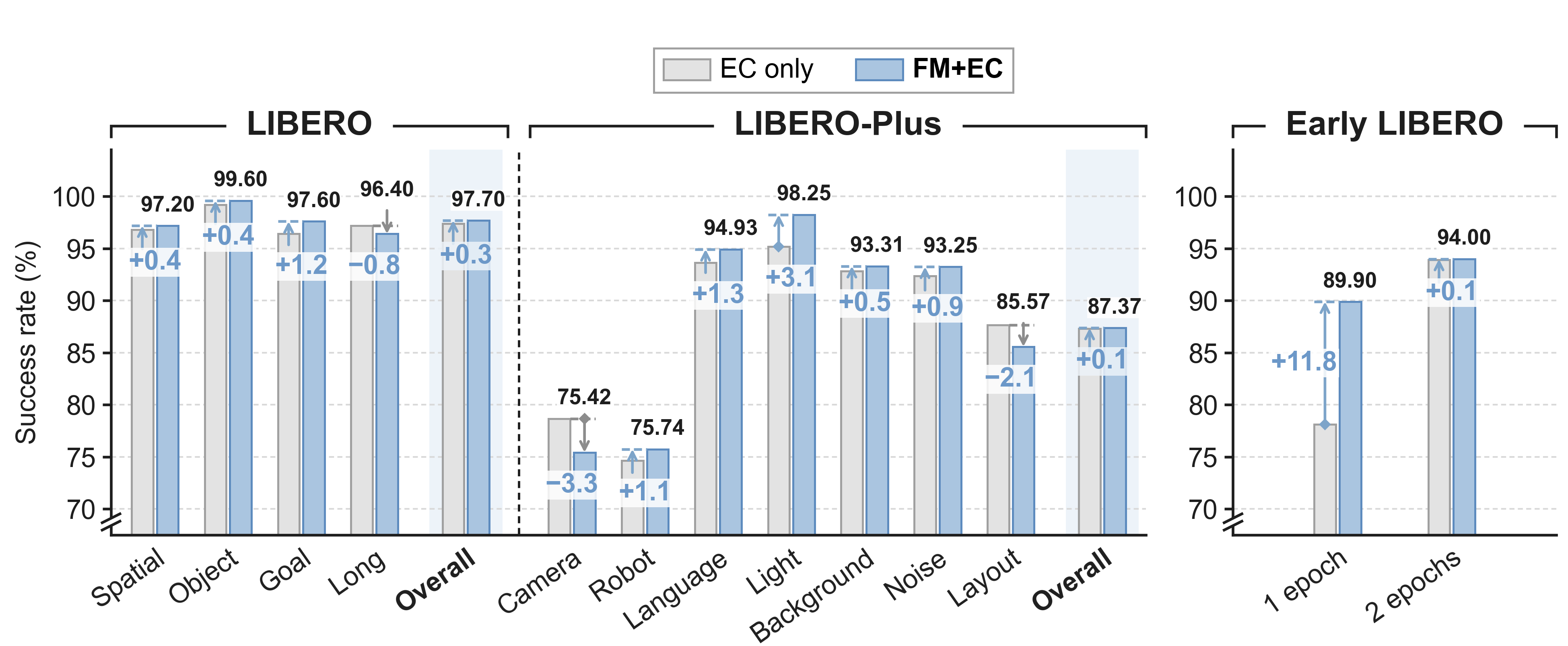
ImageWAM reaches 90% LIBERO success in 1 epoch instead of 6; Fast-WAM reaches 95% in 2 instead of 8.


ImageWAM reaches 88.55% on LIBERO-Plus, without extra embodied-data pretraining or additional fine-tuning.
| Model | Emb.PT | Spatial | Object | Goal | Long | Overall |
|---|---|---|---|---|---|---|
| VLA | ||||||
| OpenVLA | ✓ | 84.7 | 88.4 | 79.2 | 53.7 | 76.5 |
| UniVLA | ✓ | 96.5 | 96.8 | 95.6 | 92.0 | 95.2 |
| π0.5 | ✓ | 98.80 | 96.80 | 98.80 | 94.00 | 97.10 |
| π0.5 (Δ-flow) | ✓ | 99.60 | 100.00 | 99.60 | 96.80 | 99.00 |
| WAM | ||||||
| LingBot-VA | ✓ | 98.5 | 99.6 | 97.2 | 98.5 | 98.5 |
| Motus | ✓ | 96.8 | 99.8 | 96.6 | 97.6 | 97.7 |
| ABot-M0.5 | ✓ | 100.0 | 99.8 | 99.4 | 98.4 | 99.4 |
| Cosmos Policy | × | 98.1 | 100.0 | 98.2 | 97.6 | 98.5 |
| ImageWAM | × | 98.80 | 99.20 | 98.80 | 95.20 | 98.00 |
| ImageWAM (Δ-flow) | × | 99.20 | 99.60 | 98.40 | 94.00 | 97.80 |
| Fast-WAM | × | — | — | — | — | 96.60 |
| Fast-WAM-joint (Gaussian) | × | 98.40 | 99.40 | 98.60 | 93.40 | 97.45 |
| Fast-WAM-joint (Δ-flow) | × | 98.00 | 100.00 | 98.60 | 95.40 | 98.00 |
| Model | Emb.PT | Camera | Robot | Language | Light | Background | Noise | Layout | Overall |
|---|---|---|---|---|---|---|---|---|---|
| VLA | |||||||||
| OpenVLA | ✓ | 0.8 | 3.5 | 23.0 | 8.1 | 34.8 | 15.2 | 28.5 | 15.6 |
| UniVLA | ✓ | 1.8 | 46.2 | 69.6 | 69.0 | 81.0 | 21.2 | 31.9 | 42.9 |
| π0.5 | ✓ | 66.04 | 73.61 | 81.39 | 97.37 | 91.36 | 76.70 | 86.75 | 80.70 |
| π0.5 (Δ-flow) | ✓ | 73.36 | 79.35 | 83.80 | 96.94 | 97.30 | 81.26 | 87.34 | 84.53 |
| WAM | |||||||||
| LingBot-VA | ✓ | 40.9 | 83.0 | 86.4 | 82.3 | 53.1 | 64.4 | 76.2 | 69.5 |
| Motus | ✓ | 48.0 | 88.0 | 89.0 | 83.0 | 78.0 | 57.0 | 89.0 | 76.0 |
| ABot-M0.5 | ✓ | 70.5 | 87.4 | 88.6 | 94.0 | 89.7 | 75.5 | 85.2 | 83.4 |
| Cosmos Policy | × | 75.8 | 63.3 | 81.7 | 96.5 | 88.9 | 92.7 | 82.2 | 82.2 |
| ImageWAM | × | 82.55 | 52.90 | 86.99 | 97.37 | 90.24 | 92.07 | 81.31 | 82.49 |
| ImageWAM (Δ-flow) | × | 82.24 | 73.94 | 93.62 | 98.69 | 93.77 | 93.57 | 88.39 | 88.55 |
| Fast-WAM | × | 44.8 | 64.2 | 70.2 | 89.0 | 57.3 | 75.0 | 73.4 | 67.24 |
| Fast-WAM-joint (Gaussian) | × | 58.22 | 76.71 | 95.77 | 92.38 | 64.68 | 74.58 | 81.11 | 77.51 |
| Fast-WAM-joint (Δ-flow) | × | 70.04 | 78.77 | 85.43 | 91.77 | 68.12 | 88.38 | 80.79 | 80.58 |
One-step generation is 1.54–4.45× faster than ten-step Gaussian sampling.

ImageWAM achieves 4.5× lower mean action jerk than one-step Gaussian sampling.

Top: executed actions. Bottom: jerk. Shaded: each new chunk.
Illustration only. Measured results are in the figure above.
Swap the action source in frozen ImageWAM and Fast-WAM policies. No retraining.
| Policy | Source | Steps | LIBERO | LIBERO-Plus |
|---|---|---|---|---|
| ImageWAM | Gaussian | 10 | 98.00 | 82.49 |
| ImageWAM | Gaussian | 1 | 97.50 | 81.65 |
| ImageWAM | Past action | 1 | 98.10 | 82.82 |
| Fast-WAM | Gaussian | 10 | 96.60 | 67.24 |
| Fast-WAM | Gaussian | 1 | 95.55 | 68.28 |
| Fast-WAM | Past action | 1 | 96.15 | 67.58 |
Steps: inference sampling updates. Policy weights remain frozen.
Which parts of Δ-flow matter, measured on ImageWAM.
ImageWAM · LIBERO-Plus · 50% image-latent prior.
Removing visual EC lowers LIBERO-Plus success by 2.41 points. Uses the 80% image-latent prior.
What else matters when putting Δ-flow into a foundation model.
Four future frames outperform eight over the same horizon: 72.90 → 78.09% on LIBERO-Plus.
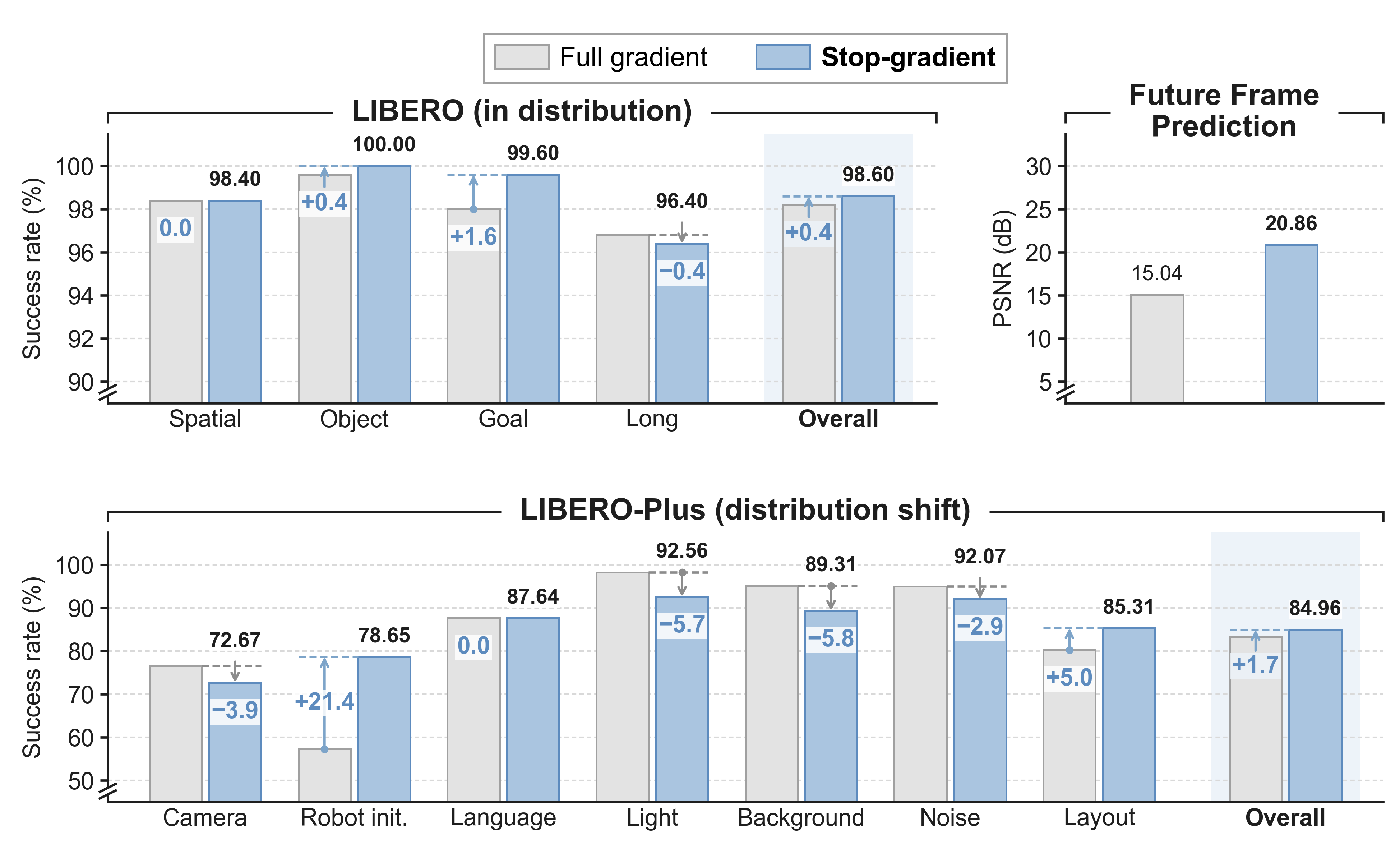
Stop-gradient improves future-frame PSNR (15.04 → 20.86 dB) and LIBERO-Plus success (83.24 → 84.96%), without visual EC.
EC-only action training nearly matches final performance; adding flow matching accelerates early learning.
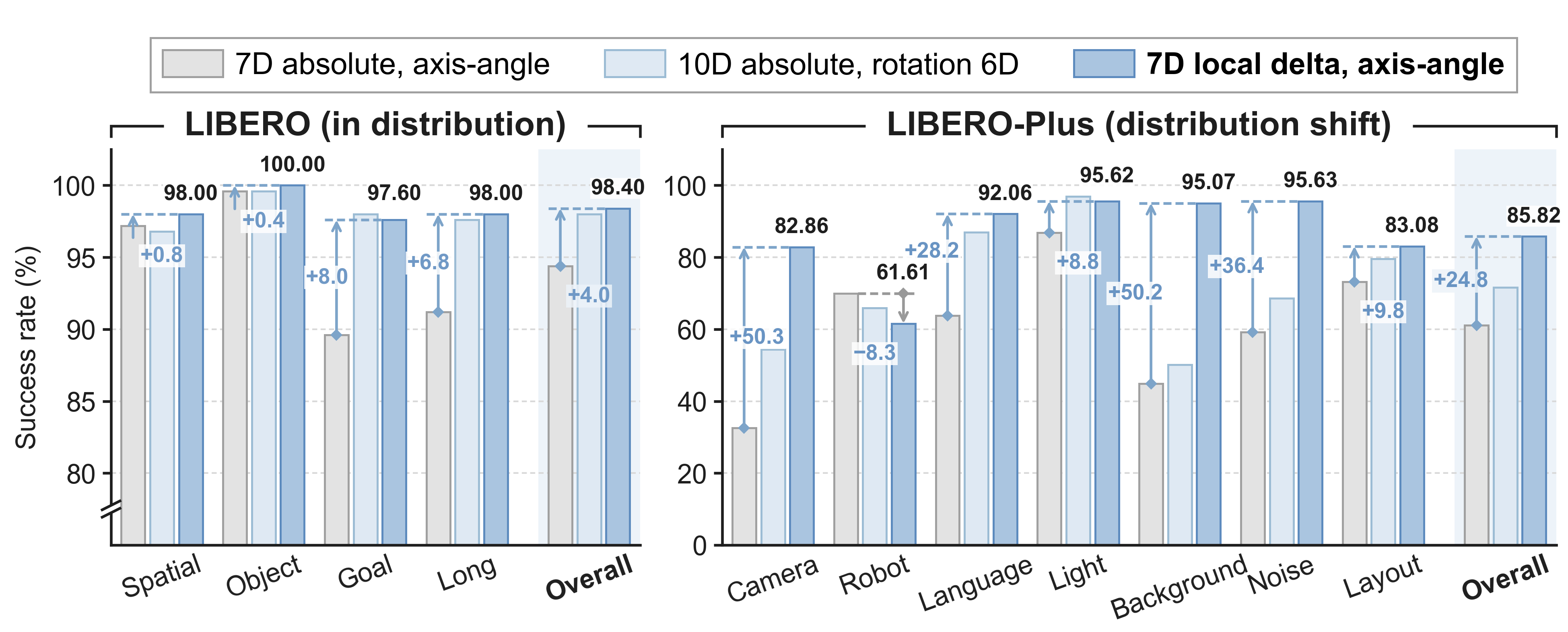
Local-delta actions generalize better overall: 85.82% versus 61.07% for 7D absolute actions on LIBERO-Plus.
No latent encoder needed
History-based visual and action sources in WAMs
VLAs and WAMs
Representation and coupling
Preprint details are pending. The citation will be updated when the paper is released.
@article{deltaflow,
  title   = {$\Delta$ Flow Matching for Robot Foundation Models},
  author  = {Zuo, Kuangji and An, Tuo and Guo, Xinying and Li, Gen and
             Zhao, Mengfei and Bai, Jiaqi and Lyu, Bofan and Yu, Zhuoyuan and
             Yang, Jinghan and Li, Jiayi and Jia, Jindou and Yang, Jianfei},
  journal = {arXiv preprint},
  year    = {2026}
}